Showing posts with label Tips. Show all posts
Sunday, 14 October 2012
How To Be A Good Boyfriend
A man can easily learn how to be a good boyfriend. All it takes is a little bit of practice and determination to do it. Willingness is the key for any man to learn how to be a good boyfriend. Unfortunately not all men are willing to study and do what it takes to be a good boyfriend.
Most men foolishly adopt a ‘love me or leave me' attitude wherein they are too stubborn to admit their shortcomings. These are usually the type of men that bank on the frailty of most women, the kind of women who would rather die than be left alone without a man.
However, men of this character must be living in the dark ages, as many women today would not tolerate this type of behavior. The modern woman of today is more discerning. Any man who would want to be in a relationship with her would certainly have to brush up on how to be a good boyfriend in order to keep her interested.
Fortunately there are still a lot of men who believe in giving their best in a relationship. These men take the initiative in learning how to be a good boyfriend to their significant other. And in the end reap the rewards of their labor with a loving and satisfying relationship.
Learning How to be a Good Boyfriend
Learning how to be a good boyfriend has a lot of advantages not just for women but also for men. A man that makes an effort to learn how to be a good boyfriend can look forward to a better and stronger relationship with their partner. An appreciative girlfriend will most likely shower her man with more love and affection than before. In addition, there will probably be less nagging that will surely be a welcome respite for any man.
However if a man still experiences the same type of treatment even after learning how to be a good boyfriend then there is something wrong. It would be a good idea to assess the relationship at this point. Perhaps the man is not to blame and the fault lies elsewhere.
Keep in mind that there are some women in the world that cannot be content unless they are nagging or criticizing something. At this point, a man may want to think if the relationship is still worth pursuing or if it would be time to move on and probably find someone who would appreciate them better.
A Guide on How to be a Good Boyfriend
A good boyfriend knows how to keep his girlfriend happy. Satisfying a woman is a comprehensive plan that does not only involve the sexual aspect of a relationship. A good way to do so is to make her feel special by complimenting her on how well she looks.
Women do their best to look pretty for their man and a little flattering remark goes a long way to show her that her efforts are appreciated. It is also a good idea for a man to evaluate his own physical appearance. As a woman takes the time to look good for her man therefore a man should also look good for his woman.
To show respect for her and her family is a trait of a good boyfriend that every man should adopt. A well-mannered man is polite and nice to his girlfriend's family. Women are particularly appreciative of a man that accepts and loves her family. Communication is a vital part of every relationship. Women cherish a man who listens and pays attention to what they have to say.
There are no hard and fast rules on how to be a good boyfriend. And learning how to be a good boyfriend is not easy. The enthusiasm to learn must be present. It is also important to be comfortable and at ease with oneself when undertaking such an education.
Being true to oneself is an important part of the learning process. A man forced into learning how to be a good boyfriend can develop negative emotions that would not be healthy for the individual and for the relationship. If a man were not interested in learning then he would only be fooling himself and his partner.
Saturday, 13 October 2012
3 Cara Untuk Membuang Virus Ramsonware
Imagine someone getting access to your computer, encrypting all your family photos and other priceless files, and then demanding a ransom for their safe return. That is what ransomware is all about. Ransomware is a type of malware used for data kidnapping. It takes your data hostage by encrypting it using supposedly unbreakable encryption algorithms and then demands payment in exchange for the decryption key.
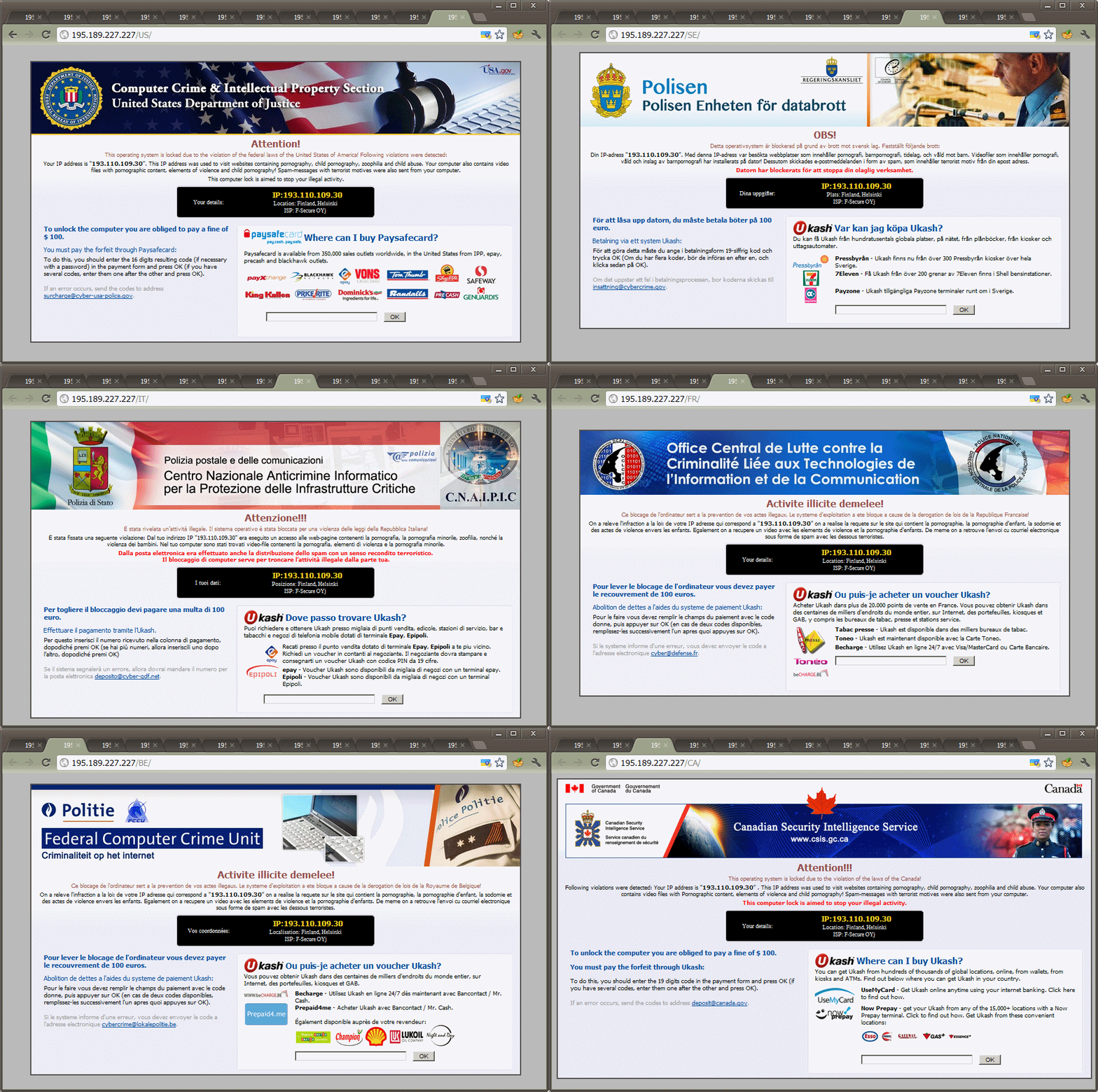
At this moment,the most common type of ransomware is the ‘Police Trojan’.This malicious program locks computers and asks their owners to pay fines for allegedly violating several laws through their online activity.
IF your computer is infected with this type of malware,you can use any of the below methods to remove this ransomware infection.
Method 1: Use HitmanPro in ForceBreach Mode
- Download the latest official version of HitmanPro from the below link.
HITMANPRO DOWNLOAD LINK (This link will open a download page in a new window from where you can download HitmanPro) - After you have downloaded HitmanPro,you’ll need to copy the file on a USB stick/CD and follow the instructions from the below video:
Method 2: Use a Kaspersky Kaspersky Rescue Disk CD
What you’ll need to perform this removal guide :
- A computer with Internet access.
- 1 blank DVD or CD
- 1 DVD/CD Burner
- Software which can create a bootable CD – http://www.imgburn.com/index.php?act=download
- A copy of the latest Kaspersky Rescue Disc from here – http://rescuedisk.kaspersky-labs.com/rescuedisk/updatable/
- About 1 -2 hours depending on how much data you have on C:
STEP 1: Download and create a bootable Kaspersky Rescue Disk CD
- Download the Kaspersky Rescue Disk ISOimage from below.
- Download ImgBurn, a software that will help us create this bootable disk.
- You can now insert your blank DVD/CD in your burner.
- Install ImgBurn by following the prompts and then start this program.
- Click on the Write image file to disc button.
- Under ‘Source’ click on the Browse for file button, then browse to the location where you previously saved the Kaspersky Rescue Disk ISO file.(kav_rescue_10.iso)
- Click on the big Write button.
- The disc creation process will now start and it will take around 5-10 minutes to complete.
STEP 2:Configure the computer to boot from CD-ROM
- Use the Delete or F2 keys, to load the BIOS menu.Information how to enter the BIOS menu is displayed on the screen at the start of the OS boot:
- In your PC BIOS settings select the Boot menu and set CD/DVD-ROM as a primary boot device.
- Insert your Kaspersky Rescue Disk and restart your computer.
STEP 3:Boot your computer from Kaspersky Rescue Disk
- Your computer will now boot from the Kaspersky Rescue Disk,and you’ll be asked to press any key to proceed with this process
- In the start up wizard window that will open, select your language using the cursor moving keys. Press the ENTER key on the keyboard.
- On the next screen, select Kaspersky Rescue Disk. Graphic Mode then press ENTER.
- The End User License Agreement of Kaspersky Rescue Disk will be displayed on the screen. Read carefully the agreement then press the C button on your keyboard.
- Once the actions described above have been performed, the Kasprsky operating system will start.
STEP 4: Launch Kaspersky WindowsUnlocker to remove the PRS for Music ransomware malicious registry changes
The PRS for Music ransomware has modified your system registry so that when you’re trying to boot your computer it will instead launch his lock screen.To remove this malicious registry changes we need to use the Kasersky WindowsUnlocker from Kaspersky Rescue Disk.
- Click on the Start button located in the left bottom corner of the screen and select the Kaspersky WindowsUnlocker.
Alternatively you can select Terminal and in the command prompt typewindowsunlocker and then press Enteron the keyboard. - A white colored console window will appear and will automatically start loading the registry files for scanning and disinfection. The whole process will take only a couple of seconds and after this process you should be able to boot your computer in normal mode.
STEP 5:Scan your system with Kaspersky Rescue Disk
- Click on the Start buttonlocated in the left bottom corner of the screen andselect the Kaspersky Rescue Disk then click on My Update Center and press Start update.
- When the update process has completed, the light at the top of the window will turn green, and the databases release date will be updated.
- Click on the Objects Scan tab, then click Start Objects Scanto begin the scan.
- If any malicious items are found, the default settings are to prompt you for action with a red popup window on the bottom right. Delete is the recommended action in most cases but we strongly recommend that you try first to disinfect , and if it doesn’t work chose to quarantine the infected files just to be on the safe side.
- When all detected items have been processed and removed, the light in the window will turn green and the scan will show as completed.
- When done you can close the Kaspersky Rescue Disk window and use the Start Menu to Restart the computer.
Method 3: Use our manual removal guide
STEP 1 :Start your computer in Safe Mode with Command Prompt
- Remove all floppy disks, CDs, and DVDs from your computer, and then restart your computer.
- Press and hold the F8 key as your computer restarts.Please keep in mind that you need to press the F8 key before the Windows start-up logo appears.
Note: With some computers, if you press and hold a key as the computer is booting you will get a stuck key message. If this occurs, instead of pressing and holding the “F8 key”, tap the “F8 key” continuously until you get the Advanced Boot Options screen. - On the Advanced Boot Options screen, use the arrow keys to highlight Safe Mode with Command Prompt, and then press ENTER.
STEP 2: Remove the malicious registry key and file
- When Windows loads in Safe Mode with Command Prompt, the Windows command prompt will show up as show in the image below. At the command prompt, type explorer.exe, and press Enter.
The Windows Explorer will open, do not close this window. - Using the same Windows command prompt,type regedit.exe and press Enter.
- The Registry Editor will now open and you’ll need to browser to :
HKEY_LOCAL_MACHINE\SOFTWARE\Microsoft\Windows NT\CurrentVersion\Winlogon\.
And search on the list to the right for an registry entry named Shell.
Right click on this registry key and select the Modify option. The default value should be explorer.exe however this infection most likely modified this entry. - Before you rename this registry entry to explorer.exe, copy the location of the modified value to a piece of paper or Notepad because this value will point you to the ransomware executable file ,which needs to be removed.
In our case, the malicious file is running from the Desktop and it’s calledcontacts.exe, but the cyber crimanls may have changed the file name in your case so it might have a different name. - Modify the value of the registry entry back to its default value
explorer.exe
Then click OK to save your changes and exit the Registry editor. - Use the window opened on Step 1 and browse to the location indicated in the value of modified registry entry and delete the malicious file. In our case, the malicious file was running from the Desktop and it was calledcontacts.exe.
- Go back into Normal Mode.To restart your computer, at the command prompt, type shutdown /r /t 0 and then press Enter.
Alternatively you can use this other manual removal guide to get rid of this trojan:
1 – Press Ctrl-O (that’s the letter O, not the number zero).
2 – Select “Browse“, and then go to C:\windows\system32 and open cmd.exe.
3 – Type “explorer.exe” into the newly opened window. You should now be able to use the desktop again.
4 – Browse to your Startup folder. The path will vary depending on the language settings and Windows version. The screenshot below shows the path on the English version of Windows XP. You will also have to replace “Administrator” with your user name in the path (unless you’re already using the Administrator account, but lets not get started on that…).
2 – Select “Browse“, and then go to C:\windows\system32 and open cmd.exe.
3 – Type “explorer.exe” into the newly opened window. You should now be able to use the desktop again.
4 – Browse to your Startup folder. The path will vary depending on the language settings and Windows version. The screenshot below shows the path on the English version of Windows XP. You will also have to replace “Administrator” with your user name in the path (unless you’re already using the Administrator account, but lets not get started on that…).
Windows 7 and Vista users can go to :
5 – Delete any entries you don’t recognize. The names of the malicious entries may be different than the ones shown in the screenshot. If you are unsure, you can remove all entries, but at the risk of disabling other valid applications from automatically starting.
6 – Reboot the computer.
C:\Users\%username%\AppData\Roaming\Microsoft\Windows\Start Menu\Programs\Startup5 – Delete any entries you don’t recognize. The names of the malicious entries may be different than the ones shown in the screenshot. If you are unsure, you can remove all entries, but at the risk of disabling other valid applications from automatically starting.
6 – Reboot the computer.
Alert-SOPA muncul kembali dalam bentuk 'ramsonware virus'
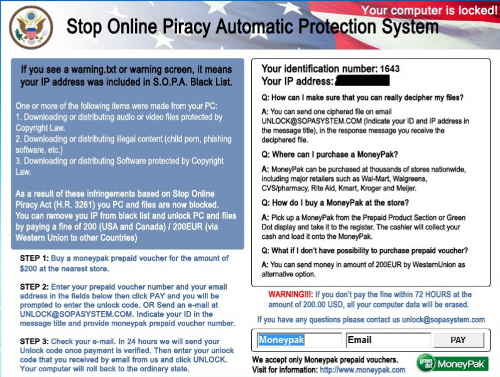
Januari dulu dunia laman sesawang digemparkan dengan tindakan SOPA atau Stop Online Piracy Act atas tindakan mereka dgn menahan beberapa individu termasuk laa kim dot com tokey megaupload..semenjak beberapa minggu kebelakangan ini ramai pengguna internet di kejutkan dgn amaran kemunculan semula SOPA sebagai nasty cryptovirus that locks up people’s computers and accuses them of distributing copyright infringing files. Infected users can get their data back after a payment of $200 –at least, that’s what the virus makers promise.
Virus SOPA ini digelar ramsonware..bila skrin pengguna yg terkena virus ni keluar seperti di dalam gambar,akan tertulis seperti ini : If you see a warning.txt or warning screen, it means your IP address was included in S.O.P.A. Black List. One or more of the following items were made from your PC: 1. Downloading or distributing audio or video files protected by Copyright Law. 2. Downloading or distributing illegal content (child porn, phishing software, etc.) 3. Downloading or distributing Software protected by Copyright Law. As a result of these infringements based on Stop Online Piracy Act (H.R. 3261) your PC and files are now blocked.
SOPA ramsonware virus.
Subscribe to:
Posts (Atom)